
Is NPI registry information public?
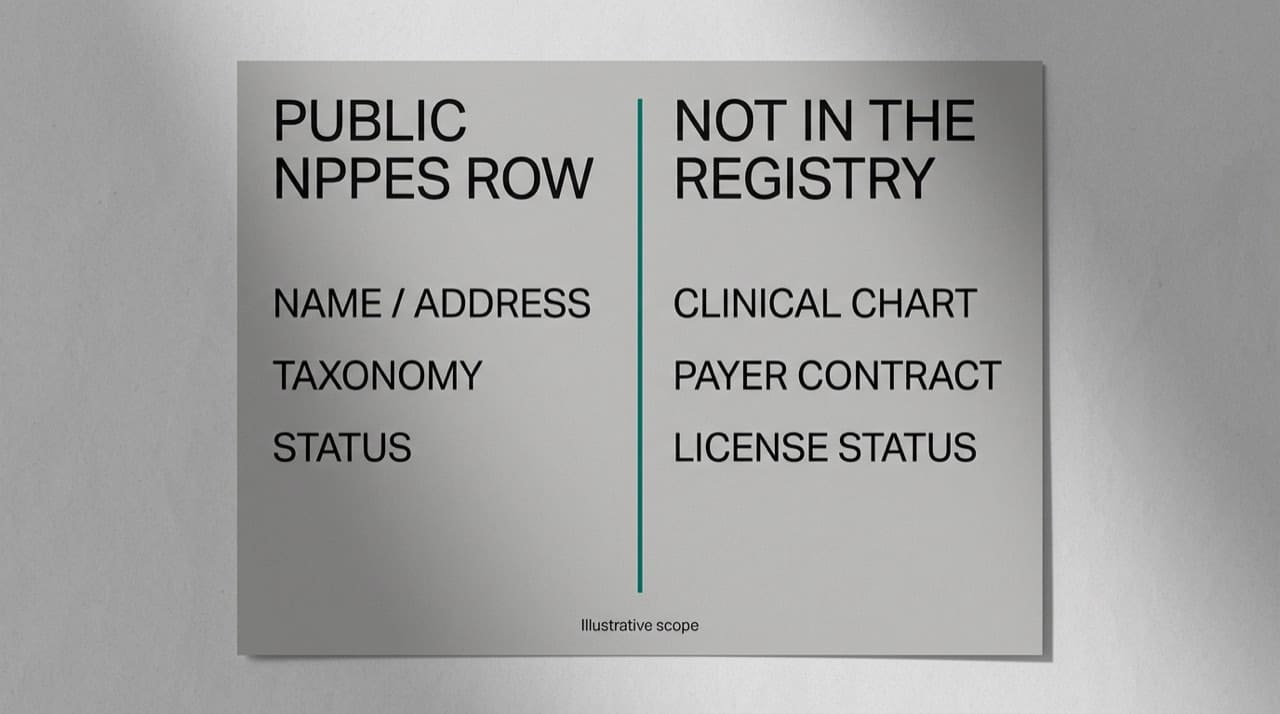
Yes, for a large subset of each enumerated record. CMS publishes NPPES data so payers, clearinghouses, hospitals, and vendors share one administrative directory. Names, practice locations, phones, taxonomy selections, and status indicators such as deactivation are ordinary public-view fields by design. That does not mean "everything about a person's life" or every line in a medical chart appears online. CMS describes registry and file products as FOIA-disclosable under applicable rules; see Data Dissemination for the agency's summary (not legal advice). The NPI overview places the registry in context.
Assume professional contact details you list for claims and enrollment can be queried or downloaded and republished by third parties. Plan communications and security accordingly.
Why payers and employers rely on the same public file
Credentialing analysts join NPPES rows to internal applications because it is faster than faxing every board every week. Fraud analysts watch for address churn. Researchers use extracts under ethics rules. All lean on the same public backbone.
NPIPublicData.org is independent. We do not issue NPIs and we cannot edit what CMS stores. For authoritative rows, use the official NPPES NPI Registry search.
Privacy expectations (what people guess wrong)
Providers: business contact information you list for claims and enrollment will be visible in some form. Patients: the registry is an identifier directory, not a rating site. Vendors: respect anti-spam law and ethics even when an address is easy to harvest.
Our Disclaimer explains how we use public data and why mirrors are not legal certificates of accuracy.
How third-party sites fit into the picture
Mirrors can add search UX or APIs; they are not magically more private or more official than CMS. See third-party NPI sites and the official registry.
When to escalate beyond a quick search
If you believe enumeration data is misused for harassment, fraud, or deceptive marketing, document it and use the appropriate regulator or law enforcement channel. We cannot change another company's marketing list or force CMS to hide a field policy marks public.
For who we are, read About us. For product issues, contact us.
Researchers, journalists, and curious patients
Journalists: cite CMS as the origin of facts you quote. Patients: cross-check address and phone with what the office gives you, then ask billing if something feels off.
Bulk extracts scale the same public columns. Strip or aggregate before you publish charts if counsel flags sensitivity in context.
Why "public" still pairs with professional courtesy
Availability is not permission to spam. Treat phone numbers as operational contact paths, not as invitations for aggressive sales scripts.
For a fast mirror while you think through boundaries, NPIPublicData.org shows the same class of data discussed here. For lookup habits, follow how to look up a provider's NPI.
Patient-facing and front-desk language
If you draft materials for patients, say the registry is an administrative directory for identifying enumerated providers, not a review site or quality score. Link curious readers to CMS for authoritative wording. Keep your own claims humble about what a quick search on a Tuesday afternoon can prove.
Front-desk staff should know that the string patients see online may include a legal business name patients never say out loud. Training reduces "the website is wrong" arguments when the row is accurate but unfamiliar.
Operations rhythm and staff turnover
Seasonal rotations are when sloppy copy-paste creeps back. Add a one-line NPPES check to the returning-worker checklist next to password resets and badge renewals. The incremental effort prevents publishing the wrong suite number on a public directory.
If you compare identifiers across systems, read NPI vs other provider IDs so tax IDs and payer "provider IDs" do not get swapped with the NPI column.
Legal teams sometimes ask whether a screenshot counts as evidence in a dispute. Treat the official registry printout as the primary exhibit; mirrors help you work faster but do not replace CMS as the source of record for what the agency published on a given date.
Practical next steps
Search your own NPI on the official registry today. Confirm which addresses and phones appear; update NPPES through authorized channels if anything is stale. Cite the official printout in internal memos, not a lagging blog screenshot.
Compliance leads: add NPPES verification wherever policy already mentions sanctions or license checks. For quick site FAQs, see our FAQ. If you need the baseline definition first, open what an NPI number is.