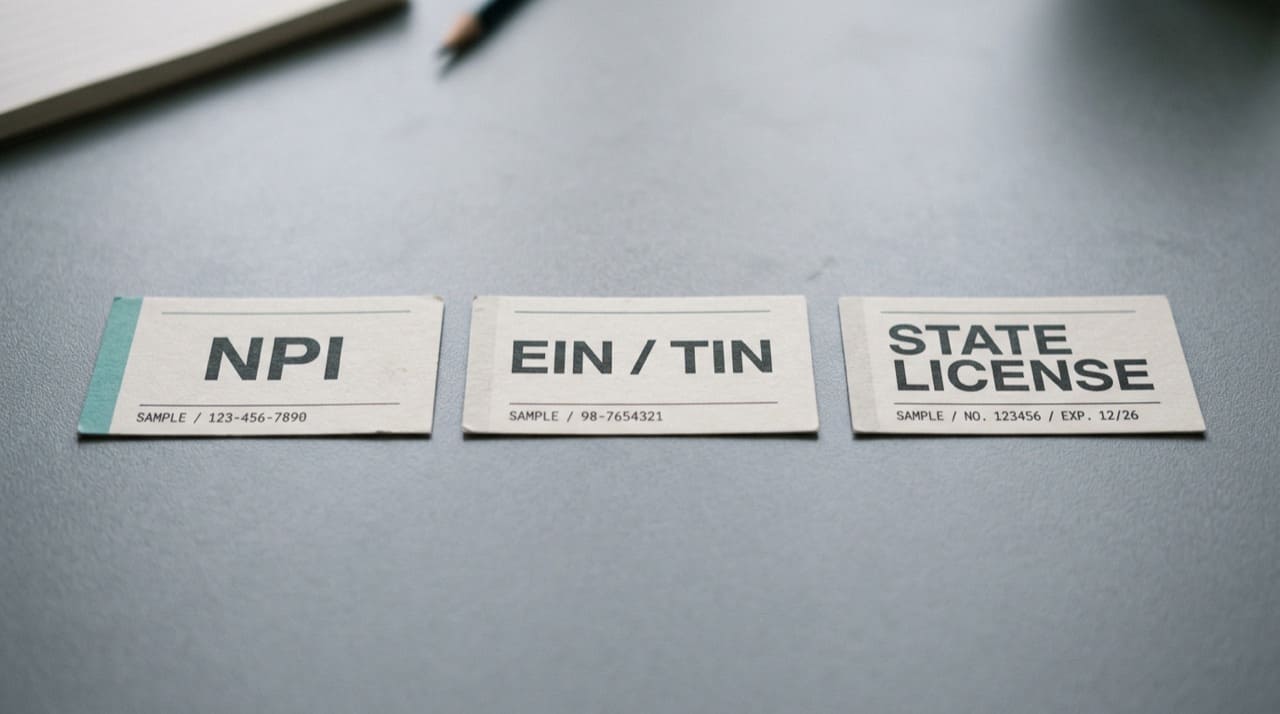
NPI vs tax ID, license, and payer IDs
The NPI is CMS’s 10-digit enumerator for health care providers on HIPAA standard transactions when the implementation guide calls for “NPI.” It isn’t your EIN or TIN, not a state license number, and not a payer’s internal “provider ID” unless that field explicitly maps to the NPI slot.
Open a credentialing PDF or a payer packet and you’ll often see a block that looks like a single “provider ID” section. Under the hood it’s usually asking for different answers: who you are for taxes, who you are for the state board, and which national enumeration you use on standard electronic transactions. Paste the wrong value into the wrong cell and the rejection message won’t politely explain your spreadsheet hygiene.
The National Provider Identifier is only the third of those stories. It’s the one HIPAA trading partners expect on standard electronic transactions when the implementation guide says “NPI.” It doesn’t replace an EIN on a W-9 story, and it doesn’t replace a license number when someone says “verify with the board.”
Tax IDs aren’t interchangeable with NPIs
An employer identification number or other tax identifier exists so the IRS and payers can reconcile money. CMS summarizes the EIN’s role in HIPAA transactions on its EIN overview; the IRS still issues the number itself. You’ll see it on W-9s, 1099s, and remittance setups. That’s a different lane from “which enumerated provider or entity is attached to this claim role.”
Clearinghouses get paid to catch files where someone jammed a nine-digit tax value into a ten-digit NPI slot because both look “numeric enough.” The edit text might say something cryptic. The fix is almost always human: reread the column header, pull the right source document, re-export.
Sole props live in the messiest overlap because one person signs tax forms and also sees patients. Enumeration guidance still treats “who is on this claim as the enumerated provider” as its own question. Your billing lead should pair CMS materials with payer examples instead of assuming the internet’s shortest blog post covers your exact structure.
License numbers answer a state question
Boards issue licenses with their own formats. Those numbers prove you met that state’s rules for a window of time. NPPES might list taxonomies that line up with how someone practices, but it isn’t a substitute for pulling the board site the payer asked for.
When compliance says “primary source,” they mean the board, not a quick NPI search screenshot. Keep that distinction in your training deck so new analysts don’t treat the registry like a license database.
W-9 moments versus claim moments
Accounting wants the tax ID on the W-9 signed the way finance requires. Billing wants the NPI where the 837 expects it. Those two conversations happen in different meetings with different attachments. When someone forwards a single PDF titled “provider setup” and expects every department to guess which page answers which system, you get Friday afternoon email chains.
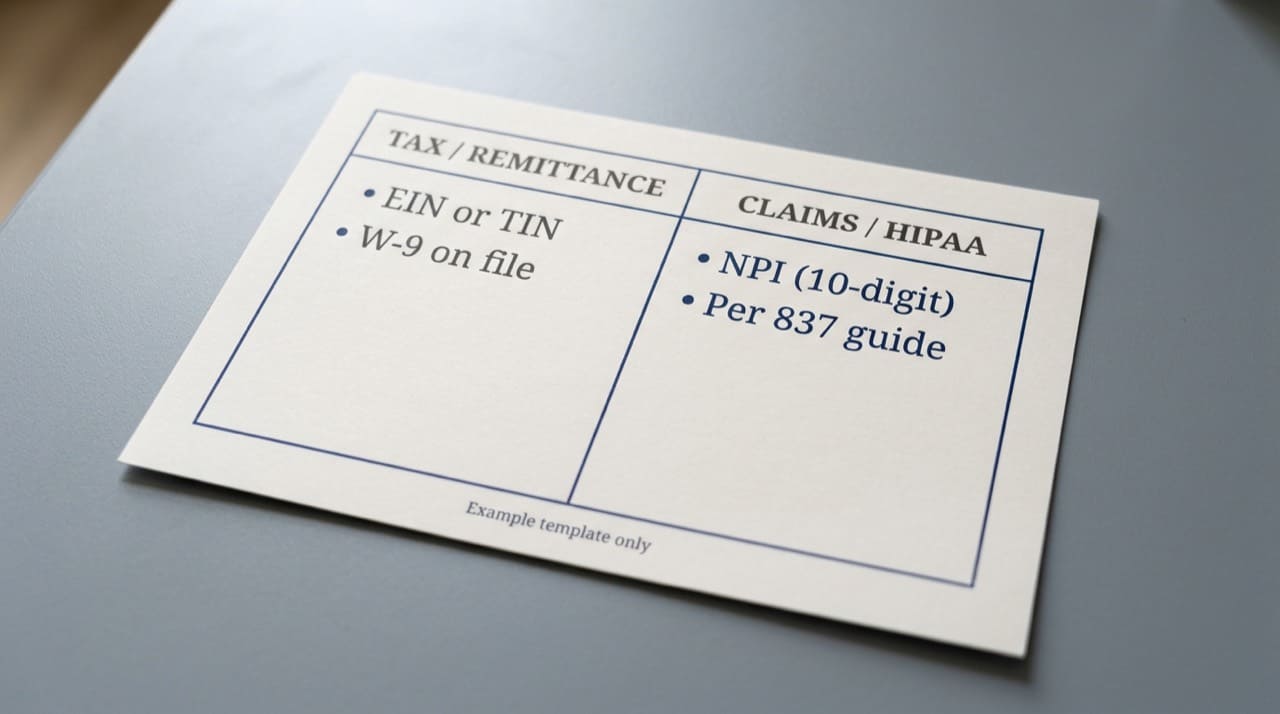
Fix it once: publish an internal one-pager with two columns, “Tax / payment” and “Claims / NPI,” and link the actual forms. Boring documentation beats heroic Slack rescues.
Program-specific IDs still show up
Medicare enrollment can introduce extra identifiers depending on supplier type, location, and enrollment path. A PTAN (Provider Transaction Access Number) is an example tied to Medicare administrative processes with your MAC; it isn’t a stand-in for the NPI on HIPAA standard transactions. Details live in Medicare provider enrollment materials and your contractor’s letters, not in a random column labeled “Prov ID.” For a higher-level map, read NPI and Medicare enrollment basics next.
Medicaid adds state-specific values. None of that disappears just because someone memorized an NPI.
Legacy labels like UPIN still show up on old paperwork or break-room posters, but today’s standard claim flows expect an NPI in the slots the implementation guides describe. When you see ten digits on a modern form, treat it as an NPI until the column header or companion guide says otherwise.
If a rejection names two different IDs, open the payer’s companion guide with the exact error code in hand, or call provider services and read the code slowly. Guessing which number “should win” wastes more time than the hold music.
Credentialing spreadsheets that don’t lie to you later
Name columns explicitly: NPI (10-digit), State license #, Practice legal name, EIN. Future you will sort and filter without emailing three departments to decode “Prov ID.”
OIG and sanctions checks are another lane that doesn’t live inside the NPI row. Your compliance team already owns that workflow; make sure the intern who only knows how to Google an NPI also knows where the exclusion list lives.
Quick checks without turning it into religion
When you need to confirm an NPI itself, the official CMS tool is the NPPES NPI Registry search. Bookmark it next to whatever internal policy says about screenshot retention.
If you’re still fuzzy on what an NPI is for, read what an NPI number is first, then come back here. If you’re about to compare people versus businesses in the registry, jump ahead to Type 1 vs Type 2 NPI explained so you’re not mixing apples and filing cabinets. For a step-by-step lookup habit, see how to look up a provider’s NPI; for how many numbers one career can carry, read how many NPIs a provider can have.
Bulk file people should skim our Downloads hub for where CMS posts full extracts; that’s a different workflow than typing one number into a portal.
When our site fits (and when it doesn’t)
NPIPublicData (this site, NPIPublicData.org) is a convenience reader for public NPPES fields. We’re not CMS. If something on our pages disagrees with what CMS shows for the same query on the same day, trust CMS for the audit trail and tell us if you think we have a display bug.
For how we handle accuracy limits and advertising, read the Disclaimer once. It’s short relative to the amount of grief it prevents later.
Vendors and “standard” spreadsheets
Software exports love generic headers like ProviderID. If you don’t map that column on import, you’ll silently poison the next system downstream. Before you cut over after a vendor change, compare their export to your old one column by column, not only row count.
If you’re the vendor, charge a few dollars more and ship templates with honest names. Your support queue will shrink.
Monday-morning habit
Before you merge a vendor’s provider roster into production, spot-check five NPIs against the official search and five tax columns against W-9s. You’ll find typos early, which is cheaper than finding them in a batch rejection report.
Keep a dated note in the ticket when two identifiers disagree; auditors love timestamps more than memory.
If you maintain a data dictionary, add a one-line sentence per identifier that names the upstream system and the refresh cadence. Future you will not remember why column seventeen exists.
When you train a new hire, have them label three sample rows using only the official definitions, not office slang. Misheard nicknames for IDs are how spreadsheets quietly fork.