What are NPI taxonomy codes?
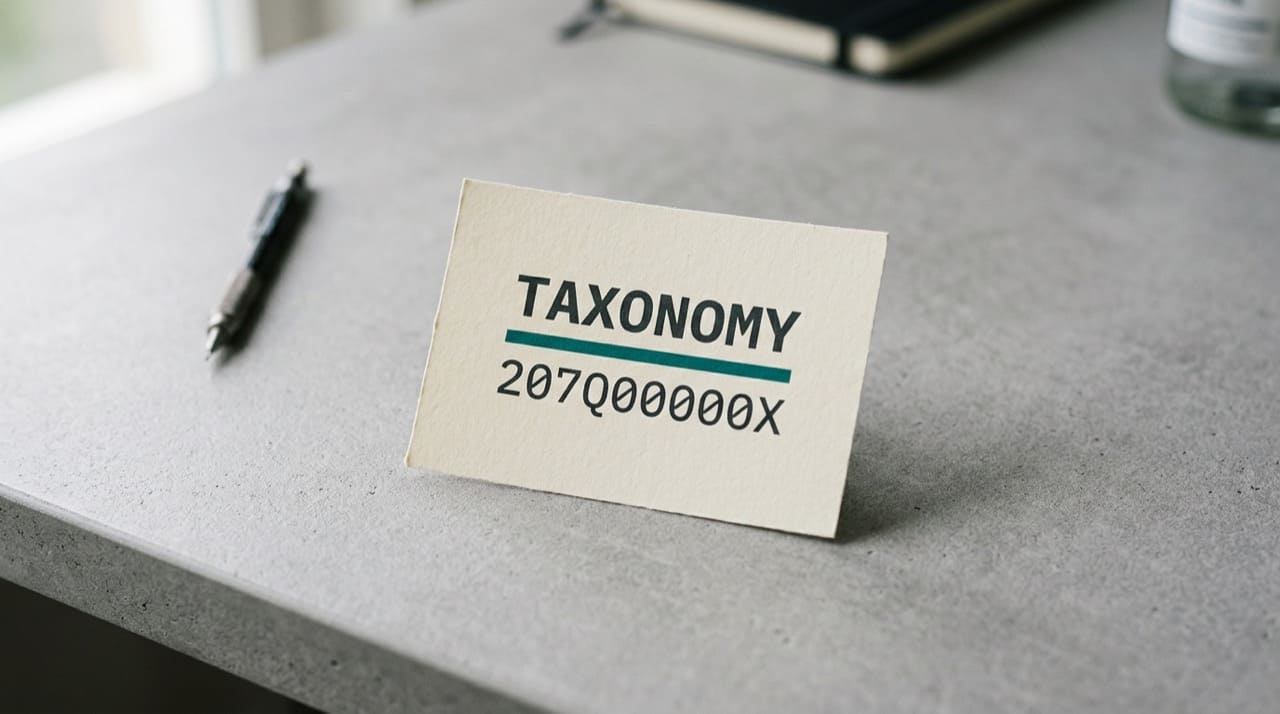
On an NPPES row, health care provider taxonomy codes are administrative labels that classify the enumerated provider or organization for trading partners: credentialing, claim edits, routing, and analytics. The list is the Health Care Provider Taxonomy, maintained by the National Uniform Claim Committee (NUCC) and adopted for NPPES by CMS. They are not ICD diagnosis codes, CPT or HCPCS procedure codes, or insurance plan names.
Most teams first see them when a payer rejects for provider-type mismatch or when credentialing asks you to confirm the primary code on file. Read the printed label twice; near-miss codes with similar titles cause a surprising share of self-inflicted denials.
For literal code definitions and updates, rely on NUCC's publications (linked in the next section), not a paraphrase from a lookup screen.
Where the code set lives (NUCC and CMS)
The authoritative code set is maintained by the National Uniform Claim Committee (NUCC) as the Health Care Provider Taxonomy. For browse-and-search access to code text, use taxonomy.nucc.org. CMS's NPI overview explains how NPPES fits the Medicare program context; taxonomy definitions still trace to NUCC.
Those codes answer a narrow question: how does the enumerated provider classify itself using the adopted standard? They coordinate systems that don't share your intuition about what "kind of doctor" someone is.
Primary versus secondary codes
A record may list more than one taxonomy when the provider or organization legitimately practices under multiple classifications that the code set distinguishes. NPPES also exposes a primary designation for which code should be treated as primary under registry rules. Payers may still apply their own edits, but the primary flag is the starting handshake between your enumeration and the outside world.
If you're cleaning data before import, store primary separately from secondaries. Teams that flatten everything into one concatenated string invite ambiguous matches later when you join to other tables.
If you publish analytics grouped by taxonomy, note which NUCC code release you mapped to. Titles and definitions shift over time, and a footnote saves you from arguing over cohorts nobody can reproduce.
What taxonomy doesn't prove
Taxonomy doesn't replace state licensure. It doesn't prove hospital privileges, board certification, or Medicare enrollment. It doesn't tell you whether a specific service is covered tomorrow. It's one administrative slice sitting next to an NPI that itself is only an identifier.
When someone says "the taxonomy looks wrong," the next step is to determine whether NPPES is stale, whether the claim used the wrong code for the service, or whether the payer's contract expects a different mapping. Those are three different fix paths.
How taxonomy shows up inside claim scrubbers
Clearinghouses map taxonomy alongside NPI into edits that sound terse on screen. You might see language about provider type, specialty mismatch, or service consistency. The scrubber isn't moralizing; it's comparing your claim's combination to tables the payer published.
When you appeal, you'll often need the enumeration snapshot from the date of service plus the payer's policy reference. Save those artifacts when the claim first denies so you're not reconstructing history from memory three months later.
Internal training decks should show one real denial screenshot with identifiers redacted. New billers remember stories better than acronyms alone.
Directories, maps, and public-facing tools
Consumer directories sometimes echo taxonomy labels when they summarize what a clinic offers. That can help patients if the label matches everyday wording. It can confuse them if the label is administrative jargon. Product teams should translate, not paste raw code strings, when the audience isn't billing staff.
If you refresh directory data from NPPES, log the file version or pull date in your UI footer. Users trust "last updated" more than silent nightly jobs.
Searching and reading results without drowning
If you only know conversational words like "skin doctor," search the official taxonomy reference for everyday keywords, then copy the exact code into your forms. Near-miss codes with similar titles cause a surprising share of self-inflicted denials.
When you compare two similar codes, read the full classification string, not only the numeric prefix. If you're still stuck, ask your billing lead for a one-line example claim from your specialty that cleared edits. Concrete examples beat abstract definitions for new hires.
Official verification habit
For evidence your compliance team will accept, pull the row on the NPPES NPI Registry search and keep a screenshot or export with a date stamp. NPIPublicData.org is built for speed while you work; it’s not a substitute for your internal policy on re-verification cadence.
Related reading and tools
If the NPI itself is still abstract, read what an NPI number is first. If you're comparing individual versus organization enumeration, open Type 1 vs Type 2 NPI explained. If you'll ingest full files, start from the Downloads hub for where CMS posts extracts, then read CMS Data Dissemination documentation before you parse bytes in production.
Shorter questions about how lookup behaves on our site often appear in the FAQ. Developers wiring validation should read the API documentation for parameters and fair use before you point production traffic at us.
When authorized users should update NPPES
If taxonomy truly changed because someone shifted how they bill, the durable correction is an update in NPPES by someone with rights to edit that enumeration. Band-aid fixes only in the practice management system guarantee the next export to a payer will re-break.
Document who owns NPPES credentials at your organization. Rotation without documentation is how two departments each think the other updates addresses and codes, and nothing moves for a year.
Taxonomy rows also appear in bulk NPPES files that analysts join to other data sets. If you run those joins, treat mismatches as a signal to inspect both sides of the join key, not as proof that either source is "lying."
Closing reminder
NPIPublicData.org isn't affiliated with CMS. We surface public data to help you work faster. When taxonomy policy or code definitions change upstream, your authoritative path is CMS and the taxonomy publisher, not a third-party blog summary.
For how we treat accuracy limits and ads on educational pages, read the Disclaimer. It pairs with guides like this when you're deciding how much weight to put on a quick browser search during live operations.
You're welcome to contact us if our page renders a code oddly compared with CMS; we can't edit NPPES on your behalf. Include a screenshot and the NPI you queried so we can reproduce the issue.
For site background and how we use public CMS data, see About us.