
What does NPI deactivation mean for billing?
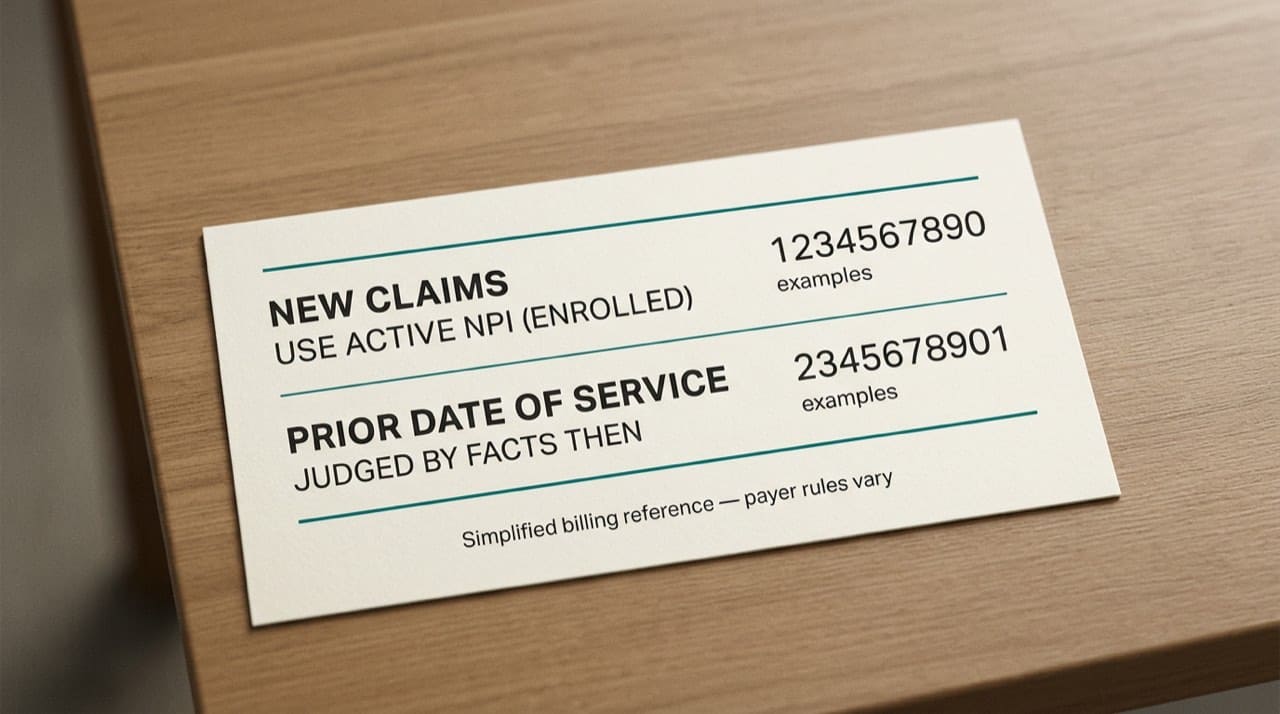
On new claims, payers usually expect an active NPI in each required slot (billing provider, rendering provider, and so on) that matches enrollment and live NPPES data. Submitting a deactivated NPI where the payer still requires an active key commonly triggers rejections or downstream clawbacks, even when the service was medically appropriate.
Payers route money using master-data keys. If the key is retired, their systems often have no active contract row to attach payment to, so they stop the transaction at the door.
Clearinghouse edits aren't a substitute for enrollment
Your clearinghouse may catch length or check-digit problems. It cannot invent a fresh enrollment relationship for a number CMS marked deactivated.
Retroactive claims and old remittances
Historical claims that correctly used an NPI before deactivation are not automatically invalid because the number later retired. Auditors care about what was true on the date of service. New claims dated after deactivation generally need today's active replacement.
For aged AR, pull the payer's written guidance. Some lines allow appeals with documentation; others insist on a currently active NPI in a specific loop.
Coordination between NPPES and payer portals
Updating NPPES does not instantly reprogram every payer's internal tables. Fix the public record with authorized users, then file payer change requests with the evidence they ask for.
NPIPublicData.org does not control either side. Verify fields on the official NPPES NPI Registry search, then reconcile to remittance data. Program context: CMS NPI overview.
Locums, billing agencies, and delegated relationships
When you bill through another entity's contract, the billing provider NPI might be the group's Type 2 while rendering stays individual. Deactivation of one number in the pair can break the combination your implementation guide expects. Map each role on paper before you change defaults.
Why status changed: context for your appeal letter
Attach a timeline: old NPI, deactivation date from NPPES, new NPI, enrollment effective date, sample claim. Keep language factual.
For bulk validation, engineers may use CMS extracts from our Downloads hub plus your data-quality rules.
When patients or partners ask what happened
Use a short script: the old number closed, the practice enrolled a new number, billing is reprocessing. Do not promise dates you cannot control.
For bugs on our site or API behavior, contact us. We cannot reactivate CMS records or override payer edits.
Medicaid, Medicare Advantage, and mixed panels
Each line of business can enforce NPI rules differently under one tax ID. Update every payer matrix when you swap numbers, not only the largest commercial plan.
Pharmacy and DME lines sometimes surface problems on different batch cycles; confirm templates did not keep the retired identifier.
Internal audits and sample sizes
After any NPI change, run a small sample of open encounters through eligibility and your claim scrubber. Ten charts that pass does not prove perfection; zero edits on a large test batch should worry you. Document who ran the test and attach registry screenshots that justified the swap.
Train billers that deactivated identifiers can still appear in search for historical reasons. Consistent vocabulary prevents "the internet is wrong" afternoons.
Practical next steps
Replace the deactivated NPI everywhere it still lives: practice management defaults, templates, superbills, and vendor integrations. Submit a small test claim if the payer allows it. Store official registry screenshots for both the old and new numbers with compliance files.
Email staff a short list: old NPI, new NPI, effective date for fresh claims, and attach payer acknowledgment when you have it. People forget verbal announcements; they search inboxes.
If you are still unsure why the number deactivated, read internal HR and contracting notes before you blame CMS. Many deactivations trace to a business decision someone forgot to broadcast to revenue cycle.
Watch for parallel changes in the same quarter: tax ID updates, new group NPIs, and payer-specific provider IDs. Fixing only the NPI while an old TIN remains on file produces a different denial that feels unrelated until you read the full rejection detail.
Credentialing packets often lag billing by weeks. If enrollment shows the new NPI but your CAQH or hospital form still lists the old one, fix both sides before you assume the claim scrubber is broken.
Read our Disclaimer when using any mirror. See the FAQ for quick reminders. For search habits, use how to look up a provider's NPI.