
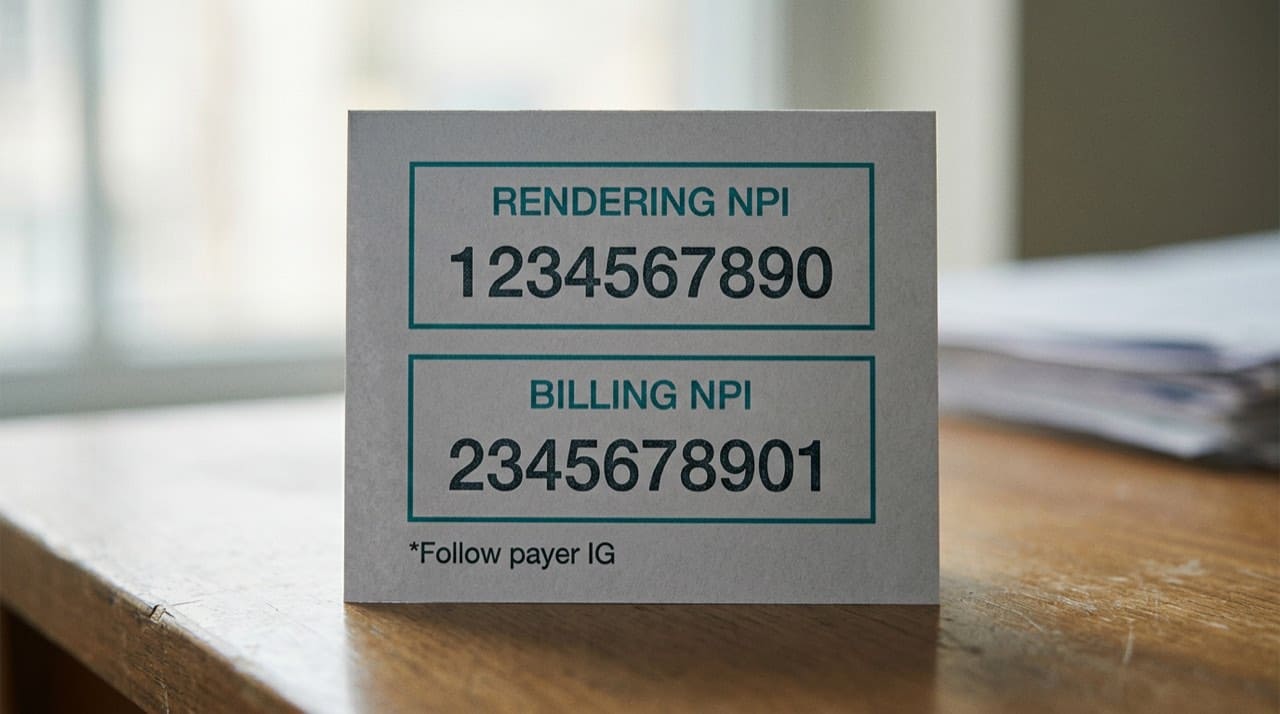
Which NPI goes in the rendering field versus the billing field?
It depends on the transaction, the payer, and the implementation guide, not on which number you remember first. Rendering usually ties to the individual or entity that furnished the service in the narrative the payer expects. Billing may point at the group, central biller, or another enrolled entity. Your clearinghouse manual and payer policy excerpts are the system of record for which loop owns which NPI on a given scenario.
Prove the public row exists and matches the spelled name you will cite using the NPPES NPI Registry search. CMS background on the identifier: CMS NPI overview. File and registry refresh context: Data Dissemination.
Type 1 and Type 2 before you rewrite macros
If the individual versus organization split still feels fuzzy, read Type 1 vs Type 2 NPI explained, then map your facility's cheat sheet to the loops your top payers use.
Clearinghouses, scrubbers, and release notes
Vendors ship rulesets that change monthly. An NPI that passed June edits may fail July when a payer tightens a linkage check. Treat release notes like operational weather. When scrubbers flag "not found," confirm which of the three failure modes you are actually fixing.
Documentation auditors expect
Keep a PDF packet per provider change: dated CMS view, payer confirmation, ticket number, and initials. Teach temps not to copy NPIs from social posts or cropped marketing PDFs where digits wrap or drop.
Automation and APIs
If you validate rows in batch, read API documentation for how we expose lookup-style access, limits, and authentication. Log API version and timestamp beside each batch so March versus April differences are explainable.
Credentialing handoffs
Billing feels the denial first; credentialing may have seen the same root cause earlier. Share a monthly example with credentialing and NPI verification workflows so both sides use the same evidence standard.
Patients and call-center scripts
Give front-line staff literal strings from NPPES for providers they name daily. The registry confirms enumeration and public fields, not clinical quality.
Modifiers, place of service, and masked root causes
Sometimes the NPI is fine while a modifier or place-of-service code triggers a front-end rejection that surfaces as a vague NPI flag in a summary report. Train triage to expand the full claim narrative in the host system before anyone opens an NPPES correction ticket. When you do need an enumeration fix, coordinate timing with enrollment so you do not solve NPPES Monday and recreate the same denial Tuesday because Medicare still shows the old string.
Remittance advice and read-aloud accuracy
Patient statements and remittance payloads sometimes bury the NPI where a rep must read it aloud. Wrong digits on the phone generate repeat calls. Build a quick reference card per high-volume provider with the exact ten-digit string and a note about common transposition mistakes your team has seen before.
Cross-training billing with credentialing
Billing feels pain first; credentialing often saw the same root issue earlier. A monthly sync with one example from each side prevents duplicate investigations. Share an internal glossary for rendering, billing, attending, and supervising that matches how your contracts use those words so plain English replaces tribal knowledge.
Flu season, year-end volume, and macro rot
High-volume weeks reward sloppy copy-paste. Add a five-minute weekly huddle that reviews one real denial and maps it to the correct field fix. Rotate who leads so senior billers stay honest about their own shortcuts.
Independent site
NPIPublicData.org does not adjudicate claims. Read the Disclaimer. Display issues: Contact us.
Practical next steps
Tomorrow, take your top denial reason. For each line, tag NPI type, payer, and whether the fix lives in NPPES, the payer portal, or your template. Close one defect class at a time. Quarterly, spot-check your twenty highest-volume NPIs against CMS on purpose so drift does not surprise you at year-end.
End-of-week discipline
Send your team lead three lines each Friday: how many denials mentioned NPI issues, which payer dominated, and whether a fix shipped. Patterns stay visible while memory is fresh, and you stop re-litigating the same scrubber rumor every month. Small habits beat heroic all-nighters after denial spikes.