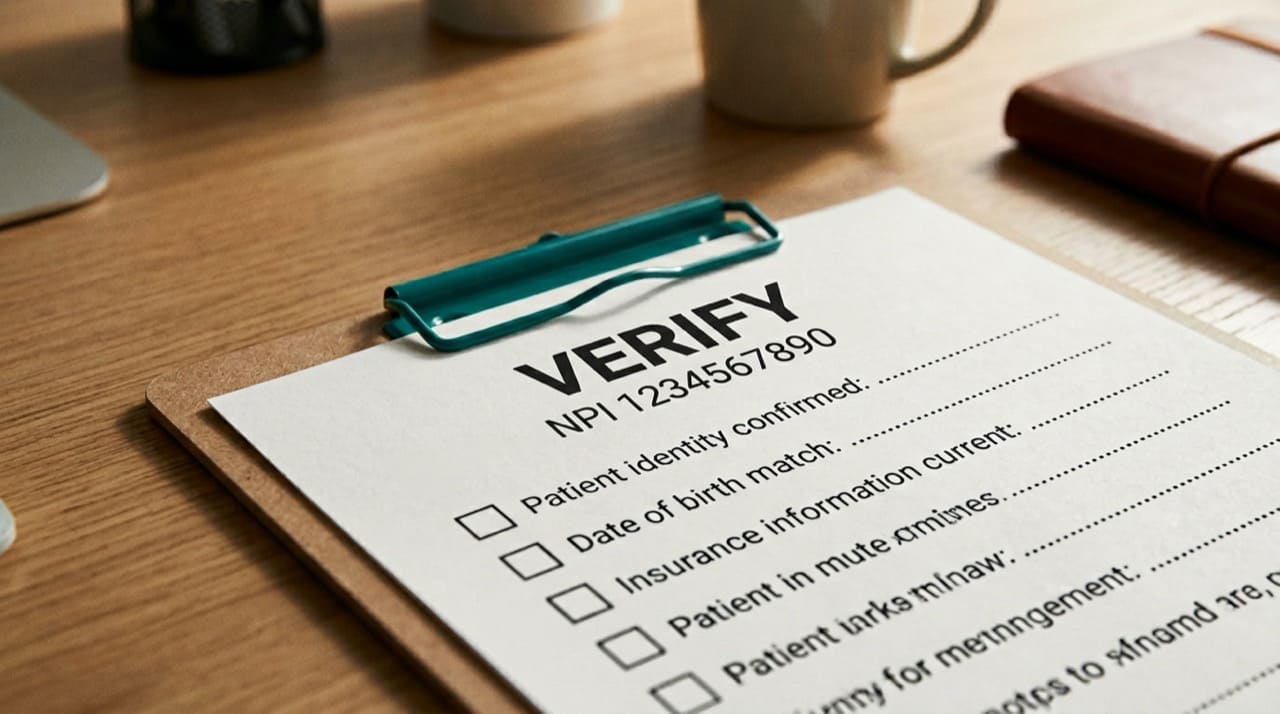
What should a credentialing packet prove about an NPI?
At minimum, a mature workflow captures legal name as enumerated, the ten-digit NPI, the practice location address that matters for the role, and the taxonomy codes your policy ties to privilege or enrollment, each with a verification date and verifier initials. NPPES is the public backbone for that slice of the story; licensure, sanctions, education, and payer enrollment are parallel tracks with their own primary sources.
Run the proof path on the NPPES NPI Registry search when your policy calls for the government view. CMS program context: CMS NPI overview. How public dissemination products are described: Data Dissemination.
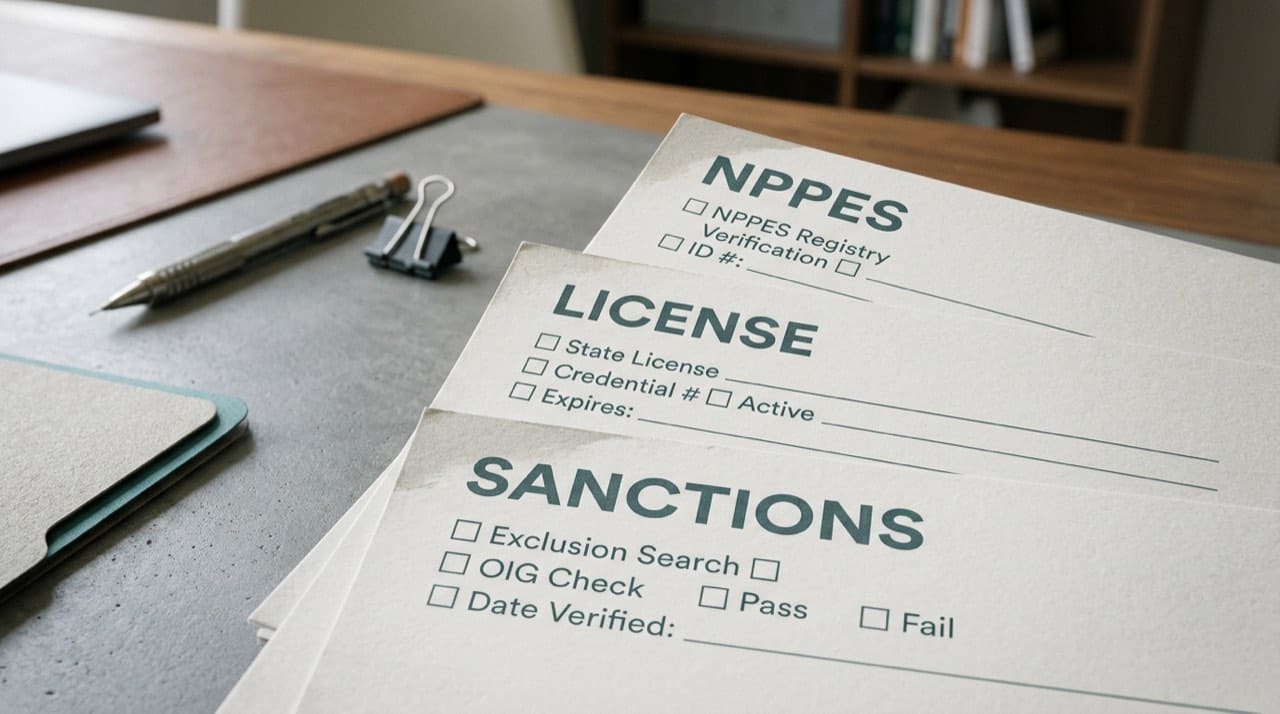
Search tactics before you escalate
Start with how to look up a provider's NPI when the registry feels stubborn. Name variants belong in name mismatches in NPI search.
What the public directory is and is not
Boundary-setting for privacy misconceptions lives in is NPI registry information public. Vendor and mirror behavior: third-party NPI sites and the official registry.
Locums, travelers, and high turnover
Ask for the NPI in the body of email, not only on attachments that get blocked. Set an expectation for how quickly your team reproduces a dated CMS view after a provider updates NPPES. Same-day checks prevent Monday surprises.
Evidence future auditors can read
Name the tool, URL, time zone, and employee on each screenshot. If you used a mirror for speed, say so and place the CMS capture beside it. Redact unrelated identifiers before wide sharing.
Trainees and supervised roles
Learner paths differ by facility. Align taxonomy and enrollment steps with medical staff bylaws, not with a guess on a web form. For trainee-oriented enumeration timing, see NPI for students, fellows, and trainees.
Handoffs to billing
When packets are thin, denials arrive first in revenue cycle. Share one real example monthly with billing, claims, and NPI basics for billers. Group context for Type 2 rows: NPI for group practices and clinics.
Quality metrics that help
Track median time from application receipt to first successful NPPES verification, not only final approval. Sample ten NPI-related denials monthly; if half trace to the initial packet, invest in the template before blaming billers.
Version control for PDFs and screenshots
Name files with ISO dates and provider initials so shared drives do not accumulate twelve artifacts all titled npi proof.pdf. Future you should open the newest evidence without guessing. When you redact unrelated identifiers, use a real redaction workflow, not opaque boxes that still leak text to copy and paste.
Remote teams, VPNs, and registry access
If analysts work from home, confirm they can reach CMS without certificate warnings that push people toward unapproved mirrors. Run the test quarterly. Keep an offline template that explains what to do when the registry is slow: wait, retry, escalate to IT, or switch to a backup procedure your security officer blessed.
International names and import quirks
Multiple naming conventions appear on passports, exam records, and licenses. Capture each variant in an internal note while still recording the exact NPPES string required on claims. Turn off aggressive auto-capitalization on imports that touch NPI rows; tiny formatting differences break naive deduplication logic.
Communication that reduces inbox thrash
Send structured updates: subject line with NPI, first bullet legal name, second bullet what changed, third bullet what you need from the recipient. Escalate with facts, not with capital letters. Everyone's inbox is already loud.
Independent site
NPIPublicData.org does not issue credentials. Read the Disclaimer. Wrong field on our site compared to CMS at the same timestamp: Contact us with specifics.
Monday packet checklist (minimum NPI proof)
Before you mark a credentialing packet "complete," capture at least:
- Dated CMS view of the Type 1 (and Type 2 when the contract is with an organization), including legal name and status.
- Primary taxonomy as shown in NPPES, with a one-line note if it differs from the specialty on the application.
- Practice and mailing addresses compared to the addresses on the privilege or payer form.
- Initials and time zone of the analyst who pulled the proof.
Use the official NPPES search for the compliance copy. Use our NPI lookup for speed during phone triage, then re-pull CMS before you file. For address field meanings, see practice location vs mailing.
Common credentialing mistakes
- Accepting a vendor portal screenshot without a CMS date: Mirrors lag. Auditors want the government view.
- Stopping at "active": Active does not mean enrolled with your payer or privileged at your facility.
- Ignoring name variants: Passport, license, and NPPES legal name can differ. Record each variant and the exact NPPES string for claims. See name mismatches in NPI search.
- Closing the ticket when billing still fails: Hand off with the same dated proof so revenue cycle does not re-investigate from zero.
- Skipping taxonomy review: A wrong specialty label on the application versus NPPES invites payer questions even when the ten digits are correct.
If you are hospital credentialing versus payer enrollment
Medical staff offices care about bylaws, privileges, and primary source verification. Payer enrollment teams care about network contracts and portal rows. Both need the same NPI string and legal name, but they close different tickets. Share one dated CMS PDF so you do not maintain two competing "sources of truth." When a locum starts Monday, verify NPPES Friday and re-check status the morning of first clinic so weekend deactivations do not surprise you. Document both pulls in the packet.
Practical next steps
Audit five recent packets for dated CMS views, initials, and taxonomy relevance notes. Fix the template before retraining people. Meet IT to document how your software ingests NPPES and how often it refreshes, then write that cadence into policy so new managers inherit facts instead of rumor.
Vendor due diligence questions
When software sits between your analysts and CMS, ask how the product surfaces deactivation, how often it refreshes, and whether historical rows are retained for audits. If the vendor cannot answer in writing, assume you still owe a dated government capture for high-risk cases. Contractual clarity now prevents blame games after the first serious outage.